
The Women in Leadership: Representation Matters, Part 1

Focusing on women in engineering—HMH’s women in engineering and specifically featuring principals Megan Cronan and Tracy Giorgetti and their careers. So far, they are our first women principals, and we love the representation they provide in our company. To commemorate Megan Cronan for reaching a decade of service with HMH, and for Tracy’s dedication this past nearly three decades, we wanted to get some background on their journey to becoming leaders in their field.
Megan Cronan grew up wanting to be a writer up until her senior year in high school. “I finally accepted that math and science were really my strong suits,” she said. She discloses that it was important for her to have a creative outlet in her career, so engineering ultimately fit that requirement and delved into each one to find the best fit. Megan explains, “I researched all the different types and landed on civil. I went into college with civil engineering as my declared major and stuck with it.”
Part of what influenced Megan’s foray into engineering was her grandfather, who happens to be an engineer. She thoughtfully recounts, “He didn’t go to college and learned everything through the military, apart from a stint at IBM. He’s a brilliant guy and at ninety years, he’s still interested in hearing about the challenges I face on my projects.” Megan proudly notes that she’s his only grandchild that went into engineering, so this career choice seems to have come full circle.
Megan launched her career here at HMH, having started as an intern after interviewing at a few different places between her junior and senior years of college. Reminiscing, Megan details… 
They say things happen for a reason, and certain moments lead up to that. It was destiny for Megan and HMH.
From starting off as an intern to eventually becoming one of two of the first woman principals in the firm, Megan’s journey felt prophetic. The idea of being part of the principal group was planted into her head by a former head of HR. She smiles…

Megan considered the fact that being part of a company for the long-haul means shifting your thought process to analyze each decision’s impact on the company as a whole and what precedents they would set. Additionally, she understands that serving as a principal means building meaningful relationships—building trust and respect between principals and overall staff. “It’s a huge leap of faith for the other principals to choose a new principal to join them, and I don’t take that lightly. I want to live up to their expectations of me,” she notes.
Hitting a decade in the field, we wanted her to share at least one highlight and one “lessons learned” situation for any budding civil engineer.

Megan says the project started pre-COVID, so the entire team, including the sub-consultants, was co-located in an office building, working together. She enthuses, “What an incredible learning experience being able to walk around the office, and ask questions of the architect, structural engineer, and geotechnical engineer all in the same stroll while getting a cup of coffee. Since working on that project in 2019, I’ve absolutely grown as a manager and engineer.” Conversely, Megan divulges that although she’s had many “lessons learned” situations throughout her career, there’s one she shares the most because it was her first huge mistake. Pausing for a moment, she says, “I was about a year and a half into my career, on my first apartment complex project. HMH was doing the construction staking1 and I was responsible for providing our Survey team with the gridlines2. I read the architectural drawings incorrectly and didn’t account for the 2 ½” stucco3 on the outside of the building. Being a zero-lot line building4, it meant it was sticking out into the public right-of-way5 by 2 ½”. Luckily, the building construction started at the other end of the lot, so one of the engineers from the Survey team caught the mistake before construction began.”
Megan was fortunate enough that her prior manager, Zeferino Jimenez, and Dave Stanton, then survey manager, understood her plight and sat with her on the phone to call the architect and structural engineer to inform them of her mistake. Dave Stanton even drove her back to the construction site to rectify the situation by telling the foreman what happened. Relieved and blown away by the empathy everyone showed her for owning up to her mistake, she felt lucky to be part of HMH and its supportive environment. Instead of behaving negatively toward Megan, everyone went into “fix-it” mode. Afterall, pointing fingers won’t solve problems.
Mentoring factors into everyone’s careers, so we asked Megan a memorable piece of advice she’s received that has helped her development. “Quoting Dave Stanton—when you make a mistake, own it,” she says immediately. Although she acknowledges mistakes happen often and can even get accused of them when it’s unwarranted, she firmly states that the result will be so much better when you own up to your own as soon as you realize it and work to develop a solution. “Most clients and consultants are understanding, and this helps develop trust and stronger relationships in the long run,” she adds.
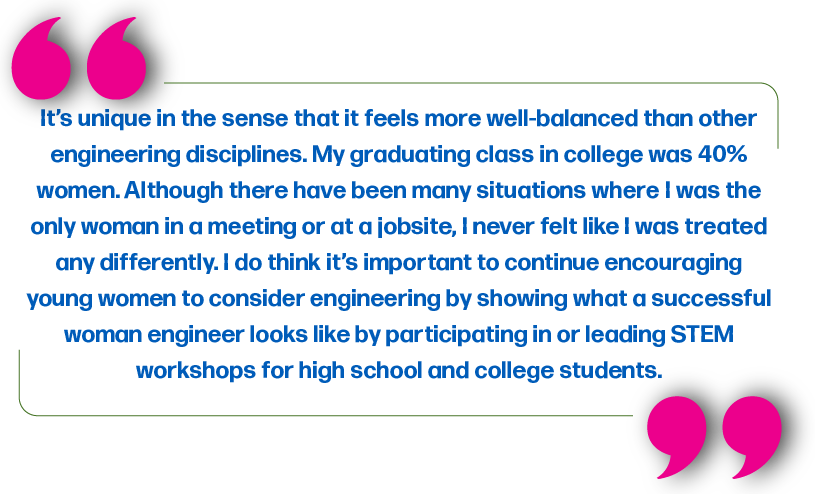
As a woman leader in civil engineering, Megan ends our conversation on this note:
Leading by example is exactly how Megan continues to exemplify what it means to be a beacon of engineering excellence. Thank you, Megan Cronan, for your dedication and loyalty all these years! Please stay tuned for Part 2, featuring Tracy.

